
On this page
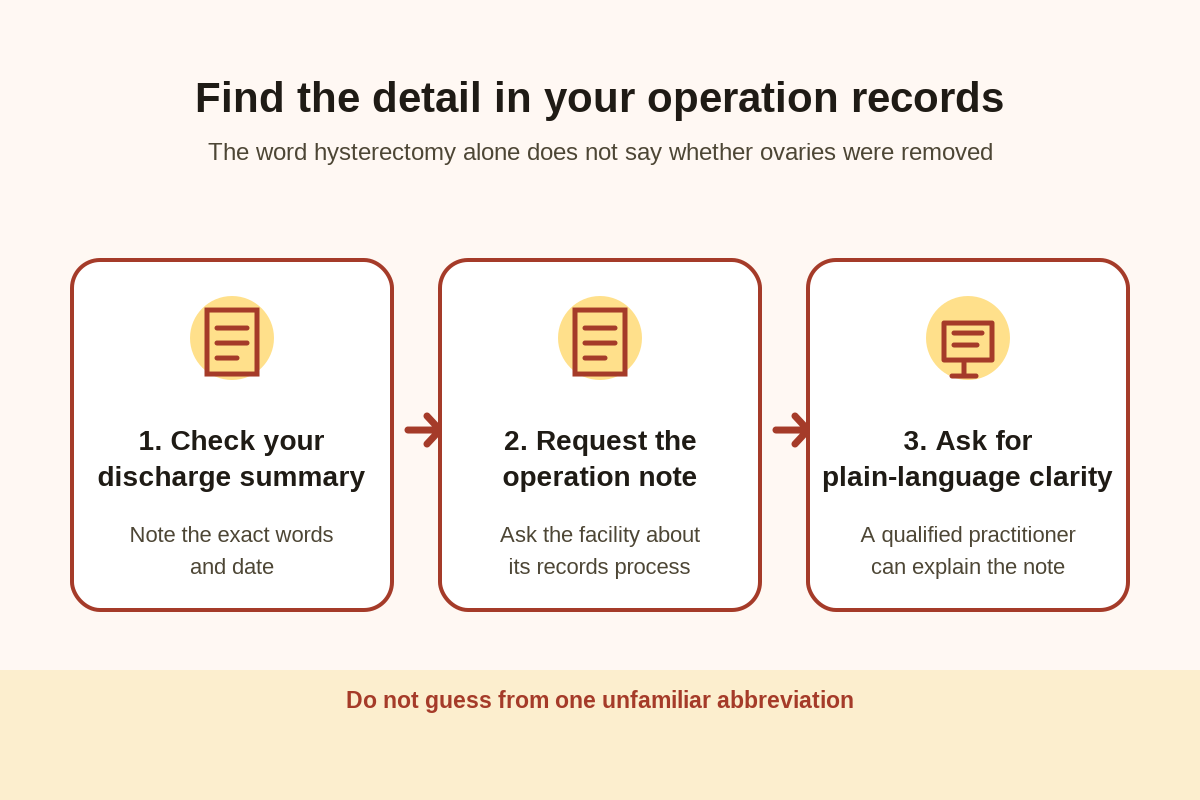
The short answer: Ask for the operation note or discharge summary, and ask the hospital or surgeon to confirm the procedure in plain language. The word hysterectomy means the uterus was removed; it does not, by itself, tell you whether one or both ovaries were also removed. The records from your own operation are the best starting point. A clinician can clarify an abbreviation or an unclear entry.
This guide is for someone who has already had a hysterectomy and wants to locate or understand the name of the procedure. It does not interpret an individual record or determine whether a symptom is related to an operation. If your concern is about a new or worrying change, contact a qualified practitioner rather than relying on a document search.
Why the word hysterectomy may not answer the question
A hysterectomy removes the uterus. Other structures may or may not be removed during the same operation. The NHS describes several procedure names, including total hysterectomy and total hysterectomy with bilateral salpingo-oophorectomy. The name of the operation and the specific structures removed are related, but the word hysterectomy alone is not enough to infer that the ovaries were taken out. The NHS overview explains the different procedure names.
The term oophorectomy means removal of an ovary. Bilateral means both sides. Salpingectomy refers to removal of a fallopian tube; bilateral salpingectomy means both tubes. Bilateral salpingo-oophorectomy (often shortened to BSO) describes removal of both ovaries and both fallopian tubes. A procedure may include removal of a uterus, cervix, tubes, ovaries, or a combination. The exact plan depends on the reason for surgery and individual circumstances.
These terms can look similar in a discharge summary, consent form, or pathology report. Do not try to settle uncertainty from one unfamiliar word. A pathology report may list tissue that was sent to a laboratory, but an operation note or a direct explanation from the treating team is better for confirming the procedure as a whole. If two records appear to differ, ask the hospital to reconcile them.
Which records can help?
Start with the papers you already have. Look for a discharge summary, operative or procedure note, consent form, and any histopathology report. The operation note usually describes what was done during surgery; the discharge summary often gives a shorter procedure name. The consent form records what was discussed or authorised before surgery, which can be useful context but may describe the planned operation rather than every detail of what happened. The pathology report records the tissue examined by the laboratory, when tissue was sent. None should be treated as a substitute for confirmation if the wording is unclear.
Search the document for terms such as ovary, ovaries, oophorectomy, bilateral, salpingectomy, adnexa, uterus, or hysterectomy. You may also see total or subtotal hysterectomy, which refers to whether the cervix was removed along with the uterus. A total hysterectomy does not automatically mean that the ovaries were removed. Record the full sentence around an abbreviation so you can ask about it accurately.
If the papers are missing, contact the hospital’s medical-records or health-information department. Give the patient name used at admission, approximate date of surgery, hospital or branch, and any record or admission number you still have. Ask what identity documents and request form are required, whether copies can be emailed or collected, the expected fee if any, and how long the request usually takes. Keep a copy of the request and note when you followed up. The hospital’s process may vary.
India’s Ministry of Health and Family Welfare hosts a Charter of Patients’ Rights that includes access to case papers, indoor patient records and investigation reports, with suggested timelines. The government’s own 2022 explanation says implementation and monitoring are for state and union-territory governments; the charter is not proof that every facility follows one identical process or timeline. Ask the facility about its applicable policy and route for requesting records. Read the Charter of Patients’ Rights and the Ministry’s explanation of state and union-territory implementation.
A simple request you can adapt
You can write or say: “I had surgery at your facility around [month/year]. Please tell me how to obtain my discharge summary and full operative note, including the name of the procedure and which organs or structures were removed. Please also let me know the identification documents, form, fee, and expected turnaround time.” If you know the surgeon or department, include that information. Avoid sending sensitive records over an unverified email address or messaging account; ask the facility how it securely provides copies.
When you receive the records, check that the patient name and surgery date match. If the procedure name is unfamiliar, circle or quote the exact wording and ask the surgeon, gynaecologist, or another qualified practitioner to explain it. Yellow’s existing-records checklist can help you organise papers, while the appointment preparation guide offers questions for a follow-up conversation. These tools support navigation; they do not interpret a record.
What the record can and cannot tell you about menopause
If both ovaries were removed before natural menopause, menopause follows immediately after the operation. If one or both ovaries remain, periods cannot be used to track menopause after the uterus has been removed, and menopause may occur earlier than it otherwise would. Those are general patterns, not a way to determine an individual’s hormone status from an operation name alone. The NHS outlines this distinction in its information about surgical menopause after hysterectomy.
A prospective cohort study followed women aged 30 to 47 who had hysterectomy without removal of both ovaries and compared them with women who did not have hysterectomy. It found a higher rate of ovarian failure in the hysterectomy group during follow-up. The researchers said it was not clear whether the operation or the underlying condition contributed. One study does not predict what will happen to a particular person, and its result should not be read as proof that hysterectomy causes menopause in every patient. Read the full study on PubMed Central.
If you have symptoms or questions, take the record and a short timeline to a practitioner. Ask what the operation involved, what the note means for your health history, and whether any evaluation is appropriate for your current concern. Do not infer that every change is due to menopause. A practitioner can consider your history and the full clinical context. This article does not recommend hormone treatment or a test, and it cannot tell you what an individual result means.
If you cannot get a clear answer
Ask the records office whether another department holds the operative note, such as medical records, surgery, or the gynaecology unit. If the hospital has closed, changed ownership, or cannot locate older records, ask what archive or successor process exists. Keep your requests factual and dated. A new practitioner may be able to explain records you do have, but should not be expected to guess what a missing note said.
If an answer from the records office conflicts with a document, ask for a written clarification and the name of the department that can review it. You may also ask the treating practitioner to explain the difference at an appointment. The official patient-rights charter lists routes and expectations, but the available grievance process depends on the applicable state, territory, facility and scheme. The PIB explanation is explicit that state and union-territory governments handle adoption and implementation. Avoid assuming that one national phone number or complaint route applies everywhere.
If you are trying to understand a new symptom, separate that question from the paperwork question. A record can add useful history, but it cannot establish the cause of a new symptom on its own. Write down when the change began, what affects it, and what you want clarified. If you feel acutely unwell or believe the situation is urgent, seek local medical care promptly rather than waiting for an old record request.
Frequently asked questions
Does “hysterectomy” mean my ovaries were removed?
No. Hysterectomy means removal of the uterus. Ovaries may be left in place or removed in the same operation. The exact operation name and operative note can clarify what was done. If the record is abbreviated or unclear, ask the treating hospital or a qualified practitioner to explain it rather than inferring from the word alone.
What does BSO mean in an operation note?
BSO usually stands for bilateral salpingo-oophorectomy: removal of both fallopian tubes and both ovaries. Abbreviations can be used differently or appear in shorthand, so check the surrounding sentence and ask the clinician or hospital records team to confirm what the note means in your specific record.
Which paper should I ask the hospital for first?
Ask for the operative note and discharge summary. The operative note is the detailed account of the procedure; the discharge summary gives a shorter overview. A consent form and pathology report may add context, but they do not always answer the same question. Request the hospital’s full records process if the first document is incomplete.
Does a hysterectomy always cause menopause?
Not necessarily. If the ovaries remain, they may continue producing hormones, although menopause may occur earlier than it otherwise would. If both ovaries are removed before natural menopause, menopause follows immediately. A record can clarify what was removed, but a clinician should discuss your health history and symptoms.
Can I tell whether my ovaries are working from my periods after hysterectomy?
No. After the uterus is removed, menstrual bleeding stops, so periods cannot show whether ovarian activity continues. Do not use the absence of periods to make a personal diagnosis. If you have a health concern, take your operation record and symptoms to a practitioner for an individual assessment.
What if the hospital cannot find my old records?
Ask whether another department or archive holds them, what identification and request steps apply, and whether a successor facility manages older files. Keep a dated record of your requests. If documents remain unavailable, tell a new practitioner what you remember and what is uncertain; do not fill gaps by guessing.
Sources and further reading
- Ministry of Health and Family Welfare, Charter of Patients’ Rights for adoption by NHRC
- Press Information Bureau, Charter of Patients’ Rights, 11 February 2022
- NHS, Hysterectomy overview, last reviewed 11 October 2022
- NHS, Hysterectomy complications, last reviewed 11 October 2022
- Moorman et al., Effect of hysterectomy with ovarian preservation on ovarian function, Obstetrics & Gynecology, 2011
This resource provides general information and does not diagnose a condition or replace advice from a qualified practitioner.