
On this page
If you are in your 30s or beyond and wondering whether cervical cancer screening is available in India, the public health programme is a practical place to ask. The Ministry of Health and Family Welfare describes visual inspection with acetic acid, usually shortened to VIA, as a screening method used through Ayushman Arogya Mandirs and related primary-care services. The method and availability can vary by location, and a screening result is not a diagnosis.
This guide explains the broad public-programme pathway and helps you prepare questions. It cannot tell you when you personally need screening, interpret a result or replace a consultation. If you already have symptoms, seek assessment rather than waiting for a screening camp or the next routine screening date.
What is cervical screening for?
The cervix is the lower part of the uterus that opens into the vagina. Cervical screening looks for changes that may need follow-up before they cause a problem. It is offered to people who do not have symptoms as part of a population-level prevention approach. A screening test sorts people into those who may need more evaluation and those for whom no immediate abnormality was seen; it does not establish whether an individual has cancer.
Persistent infection with certain types of human papillomavirus (HPV) is the main cause of cervical cancer. The World Health Organization explains that HPV infection is common and that most infections clear on their own, while a persistent high-risk infection can lead to precancerous changes over time. A screening programme aims to find changes before they progress. This general background cannot estimate your personal risk or tell you which test is appropriate for you.
Screening is different from investigating a symptom. Vaginal bleeding after menopause, bleeding after sex, unusual discharge or persistent pelvic symptoms need a practitioner’s assessment even if a screening test was recently normal. A normal screen is not a reason to delay care for a new concern. Our guide to bleeding after menopause explains why that symptom should be assessed.
What does India’s public programme describe?
The Ministry’s 2016 training module for health workers describes VIA from age 30 and a five-year interval in the programme pathway. A later Ministry of Health and Family Welfare statement from July 2025 describes the public programme for women aged 30 to 65 through Ayushman Arogya Mandirs and says VIA is the primary method at Sub-Health Centres and Primary Health Centres. It also says people with a VIA-positive result are referred for further diagnostic evaluation.
These documents describe a public programme, not an individual medical schedule. The detailed operational framework is from 2016, and local services, staffing and updated state instructions may differ. The 2025 statement confirms the 30-to-65 age group and primary method, but does not set out every local interval or eligibility exception. WHO’s global recommendations describe different high-performance tests; they should not be read as the Indian programme schedule. Ask a local health worker or facility what currently applies where you live, especially if you have a prior abnormal result, a history of cervical treatment, a condition affecting immunity, or another reason for ongoing specialist follow-up.
VIA is not the same as an HPV test or a Pap test. Different tests collect different information and are used within different screening programmes. Do not assume that a private test package is needed because a neighbour or a social-media post mentions a different method. Ask which test the facility offers, why that method is being used and who will explain the result.
What happens during a VIA test?
In VIA, a trained provider views the cervix after applying acetic acid and looks for a visible change. The 2016 Ministry training module describes the acetic acid as making certain abnormal-looking areas appear white. The examination is visual: it is not a biopsy and does not provide a tissue diagnosis. The test is intended to help identify people who may need further evaluation.
The Ministry’s training material says screening should take place in a separate room with privacy and be performed by a trained provider. You can ask who will perform the test, what the examination involves and how your privacy will be protected. You may ask the provider to explain each step before it happens, request a pause, or say if you are uncomfortable. Ask the facility whether you can have a support person or a female provider if that would help; staffing and local arrangements vary.
The provider may ask about your age, previous screening, past results, cervical procedures, pregnancy or current symptoms. You do not have to guess at details. If you have a prior report, bring it or note the approximate date and what you were told. Mention any bleeding or discharge, especially after menopause or after sex, even if you came for routine screening. A symptom may change the purpose of the visit from screening to assessment.
What can a result tell you?
A negative VIA result means that the provider did not see the changes defined as positive by that screening method at that time. It does not mean that cancer is impossible, that future screening is never needed, or that new symptoms can be ignored. Ask what interval the current local programme recommends for your circumstances and how you will be contacted if the record needs updating.
A positive VIA result is not the same as a cancer diagnosis. The Ministry’s worker-training material explicitly says that a positive screen does not mean a woman has cervical cancer. It indicates that the provider saw a change that requires the next step in the pathway. That may involve a more detailed examination, such as colposcopy, or another evaluation decided by a qualified practitioner. The exact pathway depends on the result, clinical context, available service and current local protocol.
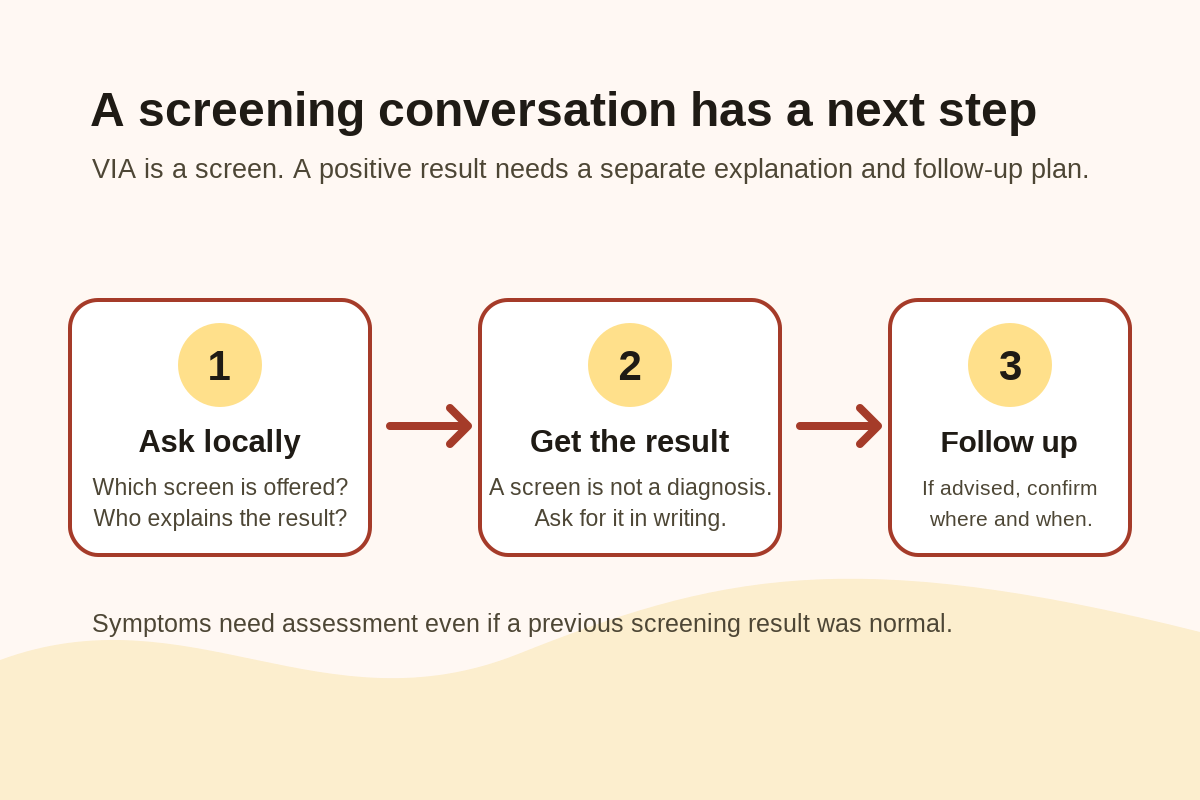
If a screen is described as positive, ask for the name of the result in writing, where to go next, whether you need an appointment or referral letter, what documents to take, how soon to follow up and whom to contact if you cannot reach the referral centre. Ask whether the first facility will help arrange the next visit or whether you need to book it yourself. A follow-up plan is part of screening; a result without a clear next step can leave you carrying unnecessary uncertainty.
How to find out whether screening is offered nearby
The Ministry’s 2025 statement identifies Ayushman Arogya Mandirs and Sub-Health Centres or Primary Health Centres as common public-programme settings. It also describes Accredited Social Health Activists (ASHAs) as helping women connect with screening. This does not guarantee that every centre offers VIA every day. Training, equipment, staffing and referral arrangements can vary between states and facilities.
You can ask an ASHA, local primary-health centre or Ayushman Arogya Mandir whether cervical screening is currently available, which method is offered, whether you need to book and whether there is a specific screening day. Ask whether the service is free or has a fee, what identification or records to bring, and where a positive result is followed up. Confirm the information directly with the facility because service details may change.
For an appointment, a small note can be enough: your age; the date and result of a previous screen if known; any past cervical treatment; symptoms; and the questions you want answered. You can use our midlife health appointment preparation sheet to organise the conversation. It is a general worksheet, not a screening recommendation.
Screening should not replace symptom care
Routine screening is for people without symptoms. If you notice vaginal bleeding after menopause, bleeding after sex, a new or persistent discharge, or another ongoing concern, contact a qualified practitioner for an assessment. Do not wait until you meet a routine screening interval, and do not assume that the symptom is caused by menopause or by cancer. Many conditions can cause similar symptoms; the purpose of assessment is to understand what is happening.
If you feel seriously unwell or have a sudden severe symptom, use local urgent medical services. This article does not provide emergency triage and does not describe every reason someone may need care. A screening visit and an appointment for a new symptom may involve different questions and tests. Tell the facility clearly if you have a symptom so that the visit can be planned appropriately.
Questions to take with you
- Is VIA the method offered in this facility, and who will perform it?
- What should I expect during the examination, and how will privacy be maintained?
- Based on my history, is today an appropriate time for screening?
- How and when will I receive the result, including if I do not hear back?
- If the screen is positive or unclear, where is the next assessment and who helps arrange it?
- Does my symptom need a separate assessment even if I am here for screening?
Begin with the question that matters most and ask for the next step to be written down. Keep a copy of results and referral notes for future visits.
Frequently asked questions
What is a VIA test for cervical cancer?
VIA stands for visual inspection with acetic acid. A trained provider views the cervix after applying acetic acid and looks for a change that may need follow-up. It is a screening test, not a biopsy or a cancer diagnosis.
At what age does India’s public programme offer cervical screening?
The Ministry of Health and Family Welfare’s 2025 statement describes the public programme for women aged 30 to 65. Ask a local facility about current availability and your personal circumstances; a population programme does not determine an individual’s care plan.
Does a positive VIA result mean I have cancer?
No. The Ministry’s training material says a positive result does not mean cancer. It means a provider saw a finding that needs further evaluation. Ask for the result in writing and confirm the referral and follow-up plan.
If my VIA result was negative, can I ignore new bleeding?
No. A screening result does not assess every later symptom. Bleeding after menopause or after sex should be discussed with a qualified practitioner even if a prior screen was negative.
Is VIA the same as a Pap test or HPV test?
No. VIA is a visual examination after applying acetic acid. Pap testing examines collected cells, while an HPV test looks for high-risk viral types. Which method is available depends on the programme and setting.
What if cervical screening is not available at my nearby centre?
Ask the facility or an ASHA where screening is currently offered and how referrals are arranged. Availability varies. If you have symptoms, request an assessment rather than waiting for a screening service to become available.
Sources and further reading
- Ministry of Health and Family Welfare, Module for Multi-Purpose Workers: Prevention, Screening and Control of Common NCDs, 2016
- Ministry of Health and Family Welfare, Training Module for Medical Officers for Population-Level Screening of Common NCDs, 2017
- Ministry of Health and Family Welfare, PIB: 10.18 Crore Women Screened for Cervical Cancer Under AAMs and NHM, 26 July 2025
- World Health Organization, Cervical cancer fact sheet, 3 July 2026
- World Health Organization, Guideline for screening and treatment of cervical pre-cancer lesions, second edition, 6 July 2021
- National Cancer Institute, Cervical Cancer Screening
This resource provides general information and does not diagnose a condition or replace advice from a qualified practitioner.