
On this page
The short answer: Migraine can become more frequent for some people during perimenopause, but research does not show that every midlife headache is hormonal or that migraine follows one predictable path. If your usual pattern has changed, write down what is different and arrange an assessment. A sudden, extremely severe headache or one with new weakness, speech trouble, confusion or loss of vision needs emergency care.
You may be trying to work out whether a headache that now arrives more often, lasts longer or disrupts your day is connected to changing periods. That is a reasonable question to take to a doctor. It is not something you have to solve before booking an appointment.
This guide looks at what studies have found about migraine around the menopausal transition, what remains uncertain, and how a brief record can make a conversation more useful. It cannot identify your headache type, establish a hormonal cause or recommend a medicine. If a headache is new or changing, let a practitioner assess it rather than using a cycle pattern as a diagnosis.
Can perimenopause change migraine?
It may be associated with a change in migraine frequency for some women. The evidence is mixed and does not support a single forecast. A 2015 systematic review found that the available studies were limited and differed in design. Its summary suggested migraine prevalence could remain stable or rise during perimenopause and decline after natural menopause, while also stressing that better evidence was needed. A review of earlier studies is useful context, not a promise about what will happen to one person.
A 2016 US observational study examined survey data from 3,664 women aged 35 to 65 who met the study's migraine criteria. High-frequency headache, defined in that study as at least ten headache days per month, was more common in the perimenopausal group than the premenopausal group after adjustment for the factors used in the analysis. Because the study was cross-sectional, it observed a relationship at one point in time. It cannot show that perimenopause caused headaches to become frequent, and its US sample does not establish the same rates for women in India.
Research after menopause also does not produce a simple rule. A 2025 population study reported that migraine cessation often occurred within the fifth decade, but many participants continued to report migraine after menopause. Its design and one-time assessment mean it cannot predict when an individual’s attacks will stop. Taken together, these findings support a careful sentence: patterns may shift, and the course varies.
If you have a migraine history, tell the practitioner what your pattern was and what it is now. If headaches are new, say that too. Neither history establishes the cause on its own.
Why can the pattern feel difficult to interpret?
Perimenopause is a transition, not a single date on the calendar. Periods may become less predictable, so it can be hard to see whether a headache repeatedly occurs near a menstrual bleed. A symptom that appears around the same time several times can be useful context, but it does not prove that hormones explain it.
Other parts of life can change at the same time. Sleep disruption, stress, a new illness, vision strain, neck pain, dehydration, changes in routine or a medicine change may be relevant. This list is not a self-diagnosis checklist. It is a reminder to describe the whole situation rather than attributing every headache to menopause.
Some people have migraine with aura, which can involve temporary visual, sensory or speech symptoms. Do not assume a first, sudden or unusual neurological symptom is aura. Use the urgent guidance below and get assessed.
Hormonal contraception or menopause-related medicines may also matter to a clinical discussion. Note what you use and when it changed. This article does not recommend starting, stopping or changing any medicine. If you already have a treatment plan for migraine, take it to the appointment and ask the prescriber whether the plan needs review.
What should you write down?
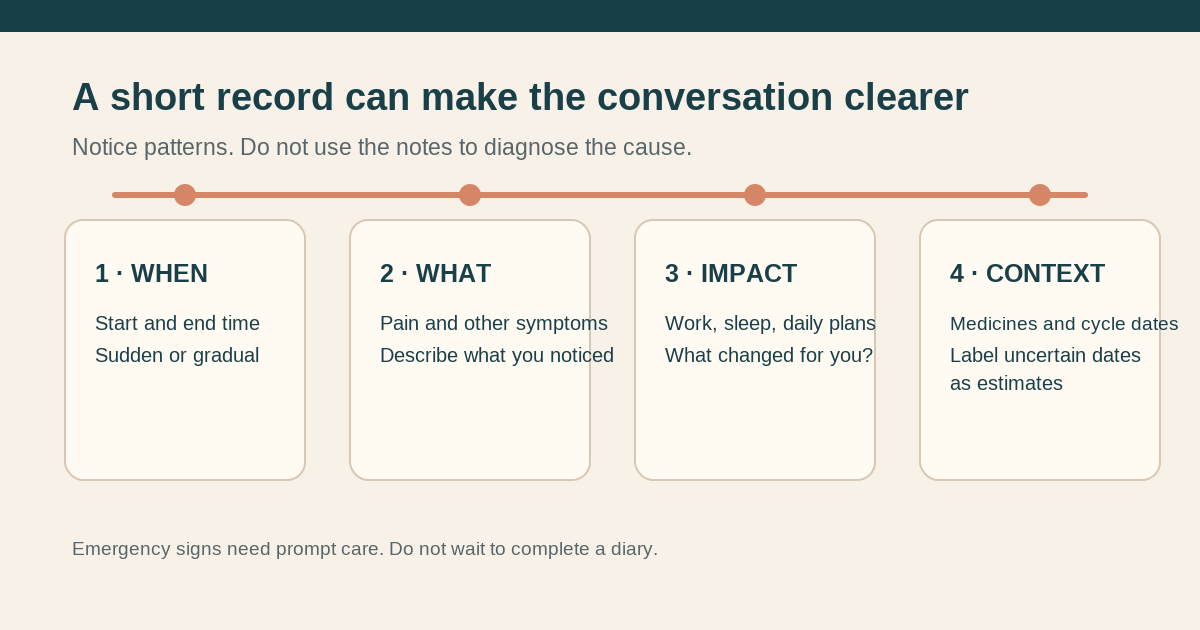
A short headache diary can help you and a practitioner see what has happened over time. You do not need special software or a perfect record. The National Institute of Neurological Disorders and Stroke suggests noting timing, duration, intensity, associated symptoms, activity beforehand and medicines taken. If you menstruate, cycle dates can add context. Start with what you remember and label estimates as estimates.
For each episode, note:
- the date and approximate start and end time;
- whether it began suddenly or built gradually;
- where the pain was and how you would describe it in ordinary words;
- nausea, light or sound sensitivity, visual changes, weakness or other symptoms;
- what you were doing before it began and whether it affected work, sleep or daily activity;
- any medicine you took, including the name if known, and what happened afterwards;
- period dates if relevant, including uncertainty when cycles are irregular; and
- recent changes such as a new prescription, illness or substantial sleep disruption.
Do not delay an appointment while filling out a diary. If the problem is concerning, book first and bring whatever notes you already have. A practitioner may ask follow-up questions or examine you before deciding whether any tests are relevant. There is no universal blood test that can prove a particular headache is caused by perimenopause.
When should a changed headache be assessed?
Arrange a medical appointment if headaches are recurring, becoming more difficult to manage, affecting your ordinary activities or changing from your usual pattern. A new headache problem, a change in how often it happens, or a new associated symptom is worth describing. The aim is not to arrive with a label. It is to give the practitioner enough detail to consider the possibilities and decide what assessment is appropriate.
Use emergency care for a headache that comes on suddenly and is extremely painful, or the worst headache you have experienced. Seek urgent help if it occurs with new weakness or numbness, difficulty speaking, loss of balance, confusion, memory changes, seizure or loss of sight. A severe headache with fever and a stiff neck, after a head injury, or with a painful red eye also needs prompt assessment. Do not wait to see whether the symptom fits a menstrual pattern or a menopause checklist.
MedlinePlus also lists headaches that worsen over a day, a first severe headache, and a changed pattern as reasons to seek medical attention. The exact route depends on severity and what is happening alongside the pain. For emergency signs in India, contact local emergency services or go to an emergency department. Do not wait for an online response, a diary entry or a routine appointment.
What can you ask at an appointment?
You can open with a simple comparison: “I used to have headaches about ___. Since ___, they have been ___.” Then explain what they stop you from doing and which symptoms come with them. If period dates or menopause-related changes seem relevant, mention them as observations rather than proof of cause.
You might ask:
- “Which symptoms mean I should seek urgent help if they happen again?”
- “Could any of my current medicines or recent changes be relevant?”
- “Would a diary help, and what details should I record?”
- “When should I follow up if the pattern continues?”
If a practitioner says the headache is likely connected to the transition, you can still ask what evidence supports that view and what else has been considered. If the explanation is uncertain, ask what to watch for and when to return. You do not need to challenge or accept a label without understanding the reasoning.
Bring your medication names or a current list, previous headache diagnoses if you have them, relevant test or scan reports, and your notes. If access or communication needs affect the visit, say so when booking or at the start. You can ask for the practitioner to explain unfamiliar terms in plain language and to write down the agreed next step.
What this evidence cannot tell you
The research does not establish that every midlife headache is migraine, that menopause is the cause, or when symptoms will stop. Studies use different populations and definitions, so their findings cannot be combined into an individual forecast.
Much of the research is from outside India. It describes possible patterns, not a local estimate for every population. A clear account of your symptoms is more useful than a confident internet explanation.
If you want to read more about broader changed-headache warning signs, see our guide to headaches changing in your 40s. For help keeping a concise record of changes before an appointment, use Yellow’s observation note. These resources support a conversation; they do not determine the cause or urgency for you.
Frequently asked questions
Does perimenopause cause migraine?
Research suggests headache frequency may be higher for some people during perimenopause, but the studies cannot prove that the transition caused an individual headache. Other explanations can matter too. A practitioner can assess a new or changed pattern in context.
Will migraine stop after menopause?
It may improve for some people after natural menopause, but it does not stop for everyone. Research has limitations and cannot predict an individual course. Ask for help based on how the headaches affect you now, rather than waiting for menopause to end them.
Should I track headaches against my periods?
If you still menstruate, noting period dates alongside headache days can provide useful context. Irregular dates and missed entries are normal; label uncertainty instead of guessing. Do not use a diary to diagnose yourself or postpone care.
Which details are useful in a headache diary?
Record when an episode starts and ends, how it feels, other symptoms, impact on activities, what happened beforehand, and medicines taken. Include cycle dates if relevant. A manageable record is enough to begin a conversation.
Is a blood test needed to prove a headache is hormonal?
There is no universal test that proves a particular headache is caused by perimenopause. A practitioner decides whether examination or tests are appropriate based on the full history. This article cannot interpret your results or tell you which tests to request.
When is a headache an emergency?
A sudden, extremely severe headache, or one with new weakness, trouble speaking, confusion, loss of balance, seizure or vision loss needs emergency assessment. Fever with a stiff neck, a recent head injury or a painful red eye are also warning signs. Use local emergency services in India rather than waiting for routine care.
Sources and further reading
- Ripa et al., Migraine in menopausal women: a systematic review, International Journal of Women's Health, 2015
- Pavlović et al., Perimenopause and Menopause Are Associated With High Frequency Headache in Women With Migraine, Headache, 2016
- Hagen et al., Migraine cessation and hormonal changes in women in the general population, 2025
- National Institute of Neurological Disorders and Stroke, Headache booklet
- MedlinePlus, Headaches: danger signs, reviewed 27 October 2025
This resource provides general information and does not diagnose a condition or replace advice from a qualified practitioner.