
On this page
A pelvic examination may be suggested during a gynaecology visit, but you can ask what the clinician is checking before you undress or agree to any step. That question is reasonable whether the visit is about pain, bleeding, a screening discussion or something else. An examination is not automatically required at every appointment. Its usefulness depends on the concern and what the practitioner needs to learn.
This guide is about preparing for a conversation, not deciding whether you need an examination. It cannot assess symptoms or replace care. In India, patient-rights policies and the way they are implemented can vary by state, facility and the kind of service. The Ministry of Health and Family Welfare’s Patients’ Rights Charter is a framework shared with states and union territories; the Ministry has said states and UTs are responsible for adoption, implementation and monitoring. A government hospital’s published rights page is useful for seeing one facility’s policy, but it is not proof that every hospital follows identical procedures.
Start with the purpose
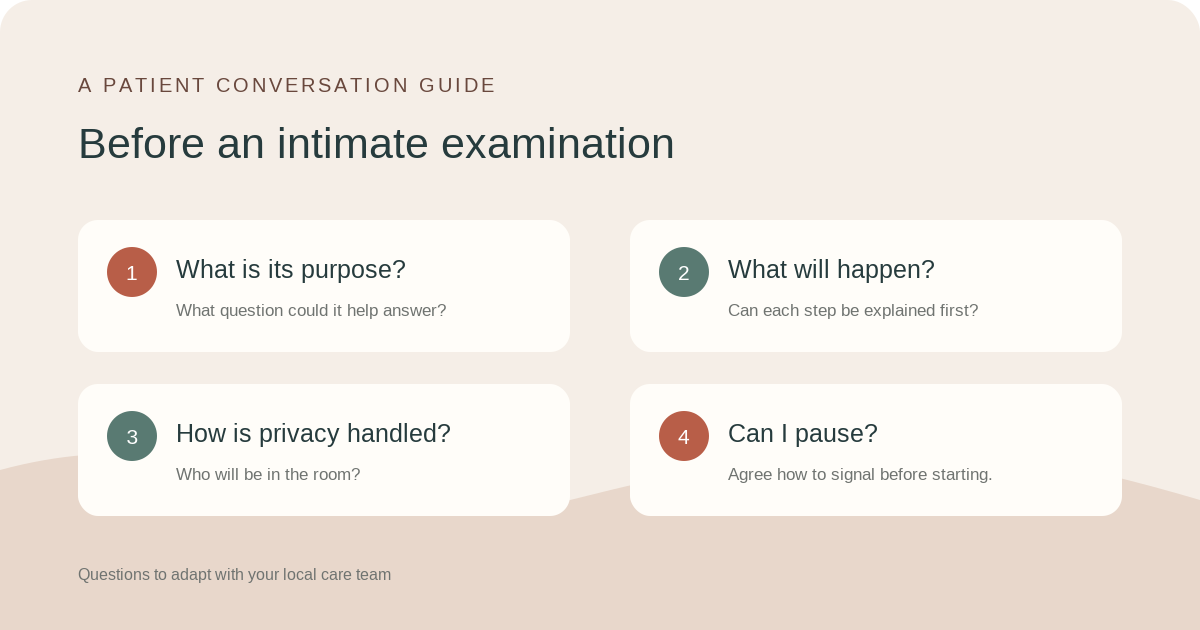
Before an intimate examination, you can ask the clinician to explain the reason in plain language. You might say, “What question would this examination help answer today?” or “Are there other ways to begin, such as discussing my history first?” The answer can help you understand whether the examination is connected to your concern, what it can and cannot show, and whether it is being proposed now or could be discussed later.
You do not need to know medical terminology. It is enough to describe what you want clarified. If the clinician uses unfamiliar terms, ask them to explain each one. You can also ask which parts of the examination are being considered. A pelvic examination may involve looking at the external genital area, using an instrument called a speculum to view the vagina or cervix, or a clinician examining with gloved fingers. Not every visit includes every part. The precise steps depend on the clinical question and local practice.
If the visit is specifically for a cervical screening test, ask what screening method is being offered and why it is appropriate in that service. India’s National Health Mission training material describes one public programme approach using visual inspection with acetic acid, performed by a trained provider in a separate room with privacy maintained. That is a description of a programme document, not a statement that every Indian clinic uses the same test or that this is the right test for every person. A screening test is also different from an examination arranged to assess a symptom.
Ask what will happen, one step at a time
It can help to know what clothing needs to be removed, whether a drape or screen is available, who will be in the room, and what equipment may be used. Ask whether the clinician can describe a step before doing it. If an instrument is proposed, you can ask what it is for. If a past examination was difficult, you may choose to say so.
The NHS explanation of cervical screening is a procedural example: a patient changes behind a screen, uses a covering sheet, and a speculum is used to see the cervix and collect a sample. This is UK service information, not a description or guarantee of what an Indian clinic provides. It can help you name practical questions, such as whether a cover is available or whether another position is possible.
You might ask, “Could you tell me before each step?” or “Can we pause if I feel uncomfortable?” If you need more time to decide, say so.
Consent, choice and stopping
The 2021 Ministry charter includes informed consent before a potentially hazardous test or treatment, along with rights concerning privacy, dignity and information. The 2019 NHRC-recommended charter also sets out informed consent for potentially hazardous tests or treatment and a right to privacy. These documents are important references, but they do not establish that every detail of every local examination is governed in the same way. The PIB’s explanation is explicit that state and union territory governments adopt and implement the charter within their remit and, where applicable, the Clinical Establishments Act framework.
The Government of NCT of Delhi’s Sanjay Gandhi Memorial Hospital lists informed consent before examination and treatment, privacy during examination and treatment, and a right to refuse or forbid a procedure. This describes that hospital’s public policy. If you attend another facility, you can ask it to explain its consent and chaperone policies. You can ask for an explanation and express whether you agree to a proposed step. You can also raise a concern if the plan changes from what was explained.
You may use a short phrase such as, “Please pause,” “I need another explanation,” or “I do not want to continue right now.” If speaking feels difficult, agree on a signal before starting, such as raising your hand. Ask the clinician to check in before moving to the next step. If you change your mind, communicate it as clearly as you can. Staff should explain what the next options are and document the discussion according to their process. This guide does not make a legal determination about a particular event or facility.
Privacy, support and a chaperone
Privacy has practical parts. You can ask who is expected to remain in the room, whether the door or curtain will be closed, how your body will be covered, and how information from the visit is handled. The NHRC-recommended charter describes privacy and confidentiality; the 2021 updated charter includes dignity and patient information rights. For a cervical screening service, the National Health Mission material says screening should happen in a separate room with privacy maintained. These are policy references. If you have a specific concern about the room or the people present, raise it before undressing.
Ask whether a chaperone is available and what that person’s role would be. A chaperone is a trained or designated person present during an intimate examination, depending on the facility’s policy. The person is not necessarily the same as a companion you bring for emotional support. Availability, eligibility and procedures differ between services. The NHRC-recommended charter states that a female patient has the right to the presence of another female person during a physical examination by a male practitioner. Since implementation depends on the relevant framework and facility, ask the clinic how it handles this request rather than assuming the answer.
If you want a companion, ask whether one can stay in the room during discussion or examination. A facility may distinguish a support person from a chaperone, and it may have privacy or space rules. You can ask how your companion’s presence will be recorded and whether any part of the appointment needs to be private. If you would prefer to speak without the companion, say that too. Your preference can change during the visit.
If language, disability or a past experience affects the visit
If a previous examination was painful or distressing, you do not have to explain more than you wish. A simple sentence can help set expectations: “I have found this difficult before, so please explain each step and check before continuing.” You may ask whether the appointment can begin with a conversation, whether a support person can attend, or whether the examination can be planned with extra time. No single approach works for everyone. You can decide which details feel useful to share.
A short checklist to take with you
You can save these questions in your phone or write them on paper:
- What is the purpose of the examination in my situation?
- Which steps are being proposed, and what might each help clarify?
- Can you explain before each step and check that I am ready?
- Who will be in the room, and is a chaperone available?
- How will my privacy and covering be handled?
- Can I ask to pause or stop, and what would happen next if I did?
- Are there other ways to begin the assessment or arrange a follow-up?
You do not have to ask every question. Pick the one that would help you make a decision. If the proposed examination follows a new or worrying symptom, do not use this checklist to postpone needed assessment. Contact a qualified local practitioner or facility and explain the concern. Seek urgent local care if you believe you need urgent help.
For broader appointment preparation, use our midlife health appointment guide. If your appointment is specifically about a cervical screening test, our India cervical screening guide covers that separate service question. These pages support preparation and do not decide which examination you need.
Frequently asked questions
Is a pelvic examination automatically part of every gynaecology appointment?
No. The clinician may first ask about your concern and history. Whether an examination would add useful information depends on the reason for your visit and the clinical question being considered.
Can I ask why an intimate examination is being proposed?
Yes. You can ask what the clinician hopes to learn, which steps are proposed and whether there are alternatives or a reason to do it today. Ask for plain-language explanations before deciding.
Can I ask the clinician to pause during an examination?
You can communicate that you need a pause or do not want to continue. Agreeing on a simple signal beforehand may help. Ask what the next options would be if you stop.
Can I request a female chaperone in India?
You can ask about the facility’s chaperone policy and request a female person. The NHRC-recommended charter describes a female attendant during examination by a male practitioner, while local implementation and processes can vary.
Does a support person have to be the same as a chaperone?
No. A companion may attend for support, while a chaperone has a separate role under facility policy. Ask whether each can be present and what the clinic records about their involvement.
What if an examination feels painful or distressing?
Tell the clinician what you are experiencing and ask to pause. You can discuss whether to stop, adjust the plan or arrange another conversation. This guide cannot determine the cause of pain.
Does the NHM cervical screening method describe every Indian clinic?
No. The cited module describes a public programme approach. Services and methods can differ. Ask the facility what it offers and whether the visit is screening or assessment of a concern.
What if I do not feel heard when I raise a concern?
You can ask for the clinician in charge or the facility’s patient-support or grievance process. Keep a factual note of what happened. The available route depends on the facility and location.
Sources and further reading
- Ministry of Health and Family Welfare, Charter of Patients’ Rights and Responsibilities, updated 23 August 2021
- National Human Rights Commission, Charter of Patients’ Rights, 2019
- Press Information Bureau, Ministry of Health and Family Welfare, Charter of Patients’ Rights, 11 February 2022
- Ministry of Health and Family Welfare, National Health Mission, Module for Multi-Purpose Workers: Prevention, Screening and Control of Common NCDs
- Sanjay Gandhi Memorial Hospital, Government of NCT of Delhi, Patient’s Rights
- Oxford University Hospitals NHS Foundation Trust, Having an Intimate Examination in Gynaecology Services
- NHS, What happens at your cervical screening appointment, reviewed 26 June 2025
This resource provides general information and does not diagnose a condition or replace advice from a qualified practitioner.